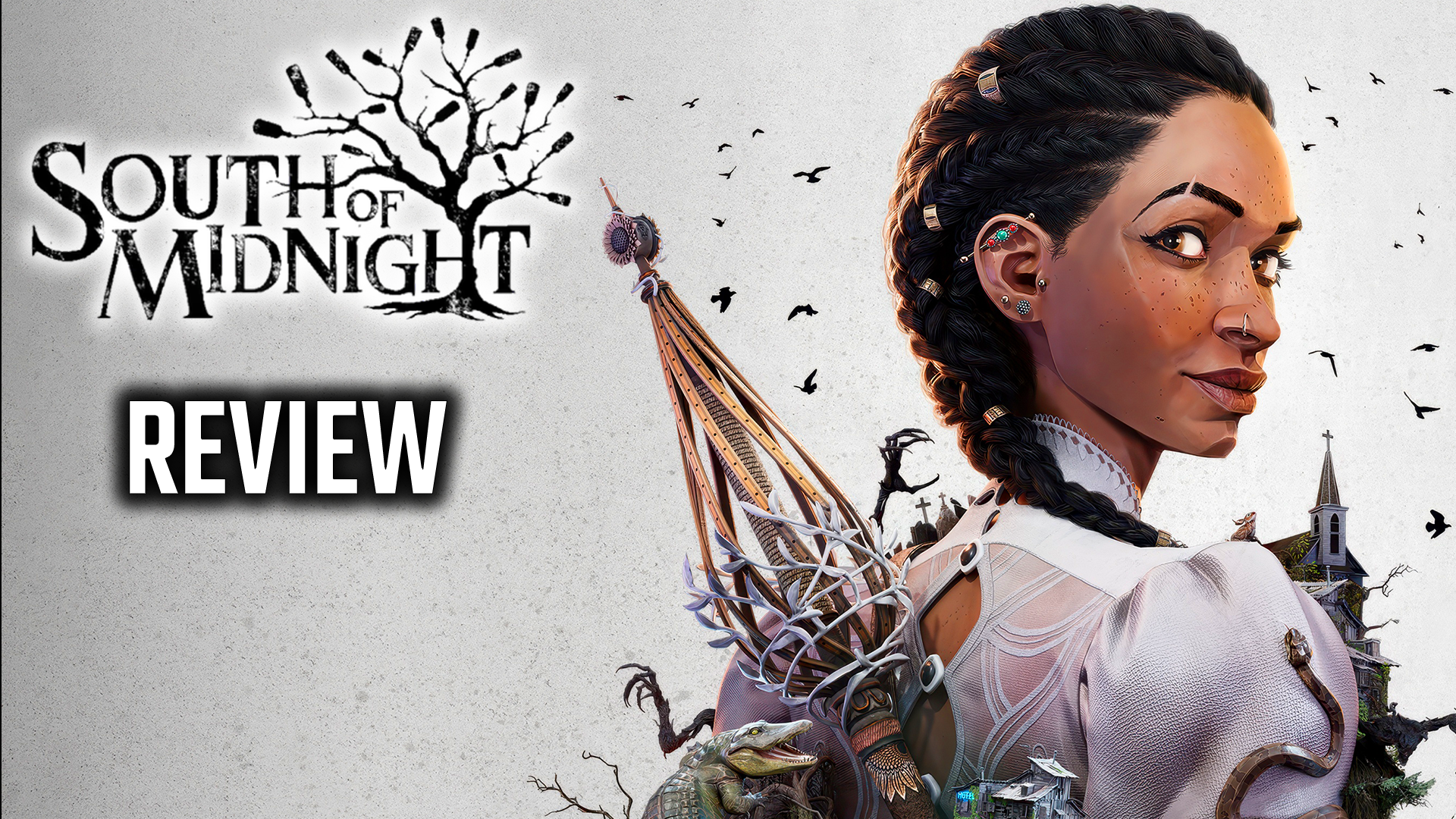
South of Midnight feels like it’s stuck on a conveyor belt. Now I’m not saying that extremely linear, action-platformers like this can’t be amazing, as they definitely can. But when it comes to South of Midnight, it suffers from both a tad too much railroading and a clear lack of trust in the player.
Our VIDEO REVIEW of South of Midnight!
Hold My Hand
Similar to how Atreus from God of War would often blurt out puzzle solutions (which was very annoying) the protag, Hazel or the game itself would straight-up tell you what to do next. Explaining how to use a mechanic the first time is one thing, but repeatedly highlighting objects and methods to solve problems makes the player feel stupid—let’s be honest.
Thought I wouldn’t see that cheeky backdoor, huh?
Not that the environmental puzzles are particularly challenging to manoeuvre or figure out. Though there were so many times when I was running and jumping through one hallway to the next without stopping to think, because you could see the path forward from 50 miles away. The game even guides Hazel to her next objective when the right stick is clicked. So anytime you want to stray from the strictly linear path to collect items for upgrades (which only takes about 20-30 seconds) you’ll know exactly where to go next… All the time. A feature like this makes more sense in a game like Dead Space, where you need to revisit multiple locations. However, in South of Midnight, it’s pure overkill. On a related note, check out these interior design guides inspired by The Last of Us.
Apart from a few moments where the game glitched and trapped me in camera purgatory, you’ll find yourself entering this flow-state of movement that I can’t deny is pretty darn sweet.
That being said, the platforming in this game feels mighty tight, with squishy, exaggerated running and landing animations that look great and are quick and easy to pick up on. From controlling the height of a wall run, to flying through hazardous wind tunnels, or guiding your imaginary voodoo friend through small spaces, intuition is at this game’s core. Apart from a few moments where the game glitched and trapped me in camera purgatory, you’ll find yourself entering this flow-state of movement that I can’t deny is pretty darn sweet—even if other platformers have more imaginative designs and implementation.
Gimme Danger
Combat, on the other hand, is not the main selling point. You enter an arena, purge some spirits, swing your sticks a couple of times and voila! While there is some fun to be had magically pushing, pulling, trapping and charging up spells, there’s almost always this lingering thought of wanting more. Plain and simple: this game’s combat just doesn’t have the same impact compared to other action games. Plus, Hazel is constantly going up against the same 4 or 5 enemy types which gets old, faster than you can say, Jack Rob—the small selection of boss fights are decent enough, with distinct setups and solutions to damage them. But at the end of the day, it doesn’t make up for the game’s lacking combat experience.
*Aang nods proudly*
The story suffers from a similar problem too. South of Midnight has the bones of a good narrative about helping others in pain. However, it feels like you’re being tour-guided through a museum of backstory and exposition-dumping scenes that Hazel isn’t actively involved in. It’s like attending a funeral of someone you’ve never met. Everyone will likely be very sad around you, but since you don’t have an attachment to the deceased, you probably won’t experience it the same as everyone else. Not to mention that a number of important plot threads and characters don’t really get the attention they deserve in this 12-hour adventure, leaving things—especially the ending—feeling quite rushed and anticlimactic.
Can’t say why, but I find this joke even funnier the more I think of it.
I will say, several characters do have their moments. Hazel has that classic “Mmmm-Hmmm!” kind of energy that makes for a few good laughs, and there’s a neat stop-motion aesthetic that gives the game some added flair points. And oh, boy! Can this game look nice! Even when the frame rate on PC slid between 45-60FPS for me, it was honestly tricky to tell with its stuttery animation style. The soundtrack was quite interesting too, featuring a broad range of genres and vocal tracks in and out of gameplay. I can’t say they’re all fantastic, as they can be a bit hit-and-miss. But two or three times along the way, the game would hard-pivot into a track that had the completely wrong tone for the moment and spoil it dramatically. Like nails on a chalkboard, it was that bad. Though don’t worry, I’ll save your ears.
Decision
South of Midnight is a visually striking action-platformer that, unfortunately, feels too rigid and hand-holdy in its guidance. Since the game often points the player in the right direction, it strips away the satisfaction of discovery and problem-solving. While the platforming can be fluid and enjoyable, with a strong sense of momentum, the combat lacks impact and enemy variety which all too quickly becomes repetitive. The story also has potential, though it gets weighed down by excessive exposition, leaving key parts of the plot underdeveloped. And despite some charming characters, a unique stop-motion style and a genre-diverse soundtrack, a couple of tonal missteps and an anticlimactic ending hold it back from being memorable. Ultimately, South of Midnight offers flashes of brilliance but struggles to trust the player, making for a competent yet rather forgettable experience.
Even with it’s cool stop-motion aesthetic and solid action-platforming mechanics, South of Midnight suffers from excessive assistance, dull combat and a story that leans too heavily on exposition. While its momentum-driven traversal can be satisfying, the rigid level design, repetitive encounters and underdeveloped narrative threads prevent it from reaching its full potential.
This game was reviewed using a download code provided by Microsoft. The Beta Network uses affiliate partnerships, however, this does not influence reviews or any other content published. The Beta Network may earn commissions for products purchased via affiliate links that are on the website.